
Organizations operate in environments where variables multiply faster than decisions can keep up. Markets shift without warning. Technologies evolve before standards stabilize. Information expands beyond what any single leader or team can fully process. Yet, in the middle of this expanding complexity, execution still depends on clarity, focus, and speed. Leaders are expected to translate intricate realities into direction that people can act on immediately (Benmira & Agboola, 2021).
This creates a structural tension at the heart of modern management. Complexity reflects the true nature of the environment. It carries the detail, nuance, and interdependencies required for sound judgment. Simplicity, on the other hand, makes action possible. It distills direction, aligns teams, and enables coordinated execution across functions and levels. One expands understanding. The other enables movement. Many organizations attempt to resolve this tension by leaning toward one side. Some reduce complexity too aggressively, stripping away nuance in the name of speed. The result is misaligned decisions, blind spots, and fragile strategies that fail under pressure. Others absorb complexity without restraint, building layers of analysis, frameworks, and approvals. Performance suffers because they treated the tension as something that could be resolved.
The reality, however, is more demanding. Complexity and simplicity coexist as a permanent condition of leadership. They pull in opposite directions while depending on each other to produce effective outcomes. Treating them as alternatives leads to imbalance. Treating them as a tension to be managed, on the other hand, opens a different path, one where leaders learn to hold both forces at the same time and adjust continuously as conditions change.
This is where the lens of Persistent Interdependent Contradictory Tensions (PICTs) becomes useful. It reframes the issue from a problem to solve into a capability to build. Instead of asking which side to choose, leaders begin to ask how both sides can be sustained, aligned, and leveraged. The shift may appear subtle, yet it changes how decisions are made, how organizations are designed, and how performance is sustained in environments that refuse to simplify themselves.
Why This Tension Exists
The tension between complexity and simplicity does not emerge by accident. It is built into how modern organizations operate, how environments evolve, and how humans process information. Removing it is not possible. However, understanding its sources is what allows leaders to manage it with intent rather than react to it under pressure.
At the structural level, organizations face a steady increase in interdependence (Raveendran, Silvestri, & Gulati, 2020). Functions no longer operate in isolation. Decisions in one area ripple across supply chains, customer experience, regulatory exposure, and financial outcomes. Digital systems amplify this effect by connecting processes that were once separate. As a result, even routine decisions carry layers of consequence. Complexity grows as a reflection of reality, not as a design flaw. At the same time, scale introduces another dimension. As organizations expand across markets, products, and customer segments, the volume of information and the number of variables increase. Standardization becomes necessary for coordination, yet excessive standardization can erase important distinctions. Leaders are therefore pushed to simplify for alignment while preserving enough complexity to remain accurate and responsive.
Technology accelerates this tension further. Data availability has expanded beyond traditional decision-making capacity. Dashboards, analytics platforms, and real-time reporting systems provide unprecedented visibility. Yet more information does not automatically translate into better judgment. Without disciplined simplification, leaders risk drowning in detail. With excessive simplification, they risk acting on incomplete or distorted signals.
The tension is also reinforced by human cognition (Secchi et al., 2016). People are wired to prefer clarity and coherence. Simple narratives are easier to understand, communicate, and remember. Under time pressure, the tendency to reduce complexity becomes even stronger. Heuristics and mental shortcuts help speed up decisions, yet they also introduce bias and oversimplification. On the other side, individuals who attempt to account for every variable can become trapped in over-analysis, delaying action and diffusing responsibility. In addition, organizational culture also plays a role. Some cultures reward decisiveness and speed, encouraging simplified thinking even when nuance is required. Others reward thoroughness and precision, reinforcing complex analysis even when timely action is critical. In both cases, the system reinforces one pole of the tension at the expense of the other.
With these, organizations face a reinforcing loop. The environment demands complexity. The organization pushes for simplicity. Human cognition oscillates between the two. The result is a persistent pull in opposing directions, experienced daily in strategy discussions, operational decisions, and leadership communication. Seen through this lens, the tension is a stable feature of modern organizational life. Leaders who recognize this shift their focus. Instead of attempting to eliminate the tension, they begin to work with it, building the capability to hold complexity and simplicity in a deliberate and disciplined balance.
Introducing PICTs
Leaders often approach tensions with the assumption that they can be resolved through better analysis, stronger alignment, or clearer prioritization. This works for many operational problems. It does not work for tensions that are structural, enduring, and mutually dependent. Complexity and simplicity belong to this category.
Persistent Interdependent Contradictory Tensions, or PICTs, as AGILEdge calls them, provide a way to understand and manage these conditions. The concept rests on three defining characteristics.
Persistent: The tension does not disappear over time. It remains present across contexts, decisions, and stages of organizational growth.
Interdependent: Both sides are necessary for effective performance. Removing one weakens the system rather than strengthening it.
Contradictory: Each side pulls in a different direction, creating friction that cannot be eliminated without creating new risks.
This framing shifts how leaders interpret challenges. Instead of treating opposing forces as trade-offs, PICTs position them as dual requirements that must be sustained together. The question is no longer which side is correct. The question becomes how both sides can be expressed in a way that strengthens execution.
In practice, this requires a different form of leadership discipline. Traditional problem solving focuses on convergence, narrowing options until a single answer is selected. PICTs demand a form of divergence followed by integration. Leaders must first recognize the value of both poles, then design ways for them to coexist in decisions, systems, and behaviors.
This also introduces a temporal dimension. The balance between opposing forces is not static. It shifts based on context, timing, and organizational conditions. At certain moments, greater simplicity is required to drive alignment and speed. At other moments, deeper complexity is necessary to avoid critical errors. Effective leadership involves adjusting this balance without abandoning either side.
The strength of the PICT lens lies in its practicality. It does not ask leaders to accept contradiction as an abstract idea. It provides a way to work with it directly. By naming the tension, clarifying the role of each pole, and designing mechanisms to hold both, leaders gain control over dynamics that would otherwise remain implicit and unmanaged.
Reframing Complexity vs Simplicity as a PICT
When viewed through the PICT lens, complexity and simplicity shift from competing preferences into a coupled system. Each side carries a distinct function that the other cannot replace. Complexity holds the structure of reality. It captures interdependencies, edge cases, second-order effects, and the conditions under which decisions succeed or fail. Without it, strategies rest on incomplete assumptions and fragile logic. Complexity allows organizations to remain adaptive because it reflects how systems actually behave.
On the other hand, simplicity translates intent into action. It reduces cognitive load, aligns teams, and creates direction that can be executed at speed. Without it, even well-informed strategies fail to move the organization. Simplicity allows coordination because it provides a shared understanding that people can act on without hesitation.
The tension emerges because each side weakens the other when applied in isolation. Excessive complexity produces models that are accurate but unusable. Decisions stall as variables multiply and ownership becomes unclear. Excessive simplicity produces direction that is easy to follow but detached from reality. Decisions move quickly, yet often in the wrong direction.
What makes this a PICT is the interdependence between the two. Simplicity depends on complexity for its validity. Complexity depends on simplicity for its usability. One ensures that the organization is thinking correctly. The other ensures that the organization is moving effectively. This reframing replaces trade-offs with integration. Instead of reducing complexity to achieve simplicity, leaders begin to design simplicity that is informed by complexity. Instead of expanding complexity for accuracy alone, they structure it so that it can be translated into clear and actionable outputs.
In practical terms, this often takes the form of layered systems. The surface remains simple, allowing teams to act with clarity. Beneath that surface, complexity is preserved in models, data, and analysis that inform decisions without overwhelming execution. The organization does not eliminate complexity. It manages where and how complexity is held. The key shift is conceptual and behavioral. Leaders stop asking how to simplify the organization as a whole. They begin to ask where simplicity is required and where complexity must be retained. They also recognize that imbalance can occur in both directions, and that restoring balance requires deliberate adjustment rather than reactive correction.
Seen this way, complexity and simplicity are not opposing choices. They are complementary forces that, when aligned, create both accuracy and speed. The role of leadership is to hold this alignment, ensuring that neither side dominates at the expense of the other.
How the Tension Manifests in Organizations
The tension between complexity and simplicity rarely appears as an abstract concept inside organizations. It shows up in concrete moments where leaders must decide how much detail to retain and how much to reduce. These moments occur across strategy, decision making, communication, and system design, often creating friction that is felt but not always explicitly understood.
In strategy, the tension becomes visible in how direction is defined. Some organizations compress strategy into short statements and high level priorities. This creates alignment and focus, yet often masks critical assumptions and dependencies. Others develop detailed strategic frameworks with multiple layers of analysis, scenarios, and contingencies. These capture reality more accurately, yet they are difficult to translate into coordinated action. The result is either clarity without depth or depth without traction.
In decision making, the tension emerges through the balance between speed and rigor. Leaders rely on simplified heuristics to move quickly, especially under pressure. These shortcuts enable responsiveness but increase exposure to bias and incomplete reasoning. On the other side, highly analytical approaches aim to account for every relevant factor. This improves decision quality in theory, yet in practice it can delay action and diffuse accountability. The organization oscillates between acting too quickly with limited insight and acting too slowly with excessive analysis.
In communication, the tension is reflected in how messages are crafted and received. Clear and concise communication supports alignment across teams, especially in large organizations (Phillips, 2023). However, reducing messages too aggressively can remove important nuance, leading to misinterpretation or inconsistent execution. More detailed communication preserves intent and context, yet it increases cognitive load and reduces retention. Leaders face a constant decision about how much to simplify without distorting meaning.
In systems and processes, the tension is embedded in design choices. Streamlined workflows reduce friction and improve efficiency, especially for repeatable tasks. Yet many operational realities require a level of complexity to handle exceptions, compliance requirements, and interdependencies. Overly simplified systems break under real conditions. Overly complex systems become difficult to use, leading to workarounds that introduce new risks. The system either becomes rigid or becomes ignored.
Across these domains, organizations tend to favor one side of the tension based on culture, leadership preference, or historical success. This creates a temporary sense of stability, yet over time the neglected side reasserts itself through performance gaps, errors, or inefficiencies. The tension does not disappear. It resurfaces in different forms. Recognizing these manifestations is critical because it shifts the conversation from isolated issues to a shared underlying dynamic. What appears as a communication problem, a strategy misalignment, or a process inefficiency often traces back to an imbalance between complexity and simplicity. Naming the tension allows leaders to address the root condition rather than treating each symptom independently.
Applying PICTs: From Either Or to Both And Leadership
Shifting from an either or mindset to a both and approach requires more than awareness. It demands deliberate mechanisms that allow complexity and simplicity to coexist in everyday decisions. Without structure, leaders tend to revert to familiar patterns, especially under pressure.
The first shift happens at the level of thinking. Leaders must hold two questions at the same time. What level of complexity is required to understand the situation accurately. What level of simplicity is required to move the organization forward. These questions are not sequential. They operate together, shaping how problems are framed and how solutions are designed.
From here, organizations begin to embed practices that sustain this duality.
Dual metrics Performance is assessed using indicators that reflect both poles of the tension. Measures of speed, clarity, and alignment are paired with measures of depth, accuracy, and robustness. This prevents over-optimization toward one side and creates visibility into imbalance before it becomes costly.
Structured tension dialogues Leadership discussions explicitly surface both sides of the issue. Instead of converging too quickly, teams are encouraged to articulate the risks of oversimplification and the risks of overcomplexity. This creates a shared understanding of the tension and improves the quality of collective judgment.
Layered decision design Decisions are structured so that complexity is addressed in the background while simplicity is presented at the point of action. Analytical depth informs the decision, yet the final output remains clear and executable. This allows organizations to benefit from complexity without slowing down execution.
Dynamic adjustment Leaders recognize that the balance shifts over time. During periods of uncertainty or change, more complexity may be required to avoid critical blind spots. During execution phases, simplicity becomes more important to sustain momentum. The discipline lies in adjusting the balance consciously rather than reacting after performance declines.
These practices reflect a deeper behavioral change. Leaders move away from the need to resolve tension and toward the ability to manage it continuously. This includes tolerating ambiguity, resisting premature closure, and maintaining clarity without reducing reality to convenient narratives.
The impact becomes visible in how organizations operate. Decisions are made with greater confidence because they are informed without being overloaded. Communication becomes clearer without losing meaning. Systems become more usable without sacrificing capability.
Managerial Practices
Translating the balance between complexity and simplicity into daily operations requires discipline at the managerial level. This is where the tension becomes tangible, shaping how work is designed, communicated, and executed. Without concrete practices, the intent to manage both sides remains conceptual and fades under operational pressure.
One of the most effective principles is to simplify outputs, not thinking. Managers encourage teams to engage deeply with the problem, exploring variables, dependencies, and potential risks. The complexity is preserved during analysis. The output, however, is distilled into clear direction, defined priorities, and actionable steps. Teams experience clarity without losing the benefit of rigorous thinking.
Another practice involves progressive disclosure in communication. Information is structured in layers. The first layer provides essential direction that enables immediate action. Additional layers contain supporting detail for those who need deeper understanding. This allows different parts of the organization to access the level of complexity appropriate to their role without overwhelming everyone with the same level of detail.
System design also plays a central role. Effective managers ensure that complexity is embedded within the system rather than imposed on the user. Processes are designed so that front end interactions remain intuitive, while underlying rules and logic handle variation and exceptions. This reduces cognitive load and increases compliance, while maintaining operational integrity.
Decision frameworks can also be structured to reflect the balance. Managers establish clear criteria for when deeper analysis is required and when simplified decision rules are sufficient. Routine decisions are guided by principles and predefined thresholds. Non routine or high impact decisions trigger more detailed examination. This prevents overanalysis in simple situations and underanalysis in complex ones.
Feedback loops are critical to sustaining balance (Aguilera et al., 2024). Managers track signals that indicate drift toward either side. Signs of oversimplification may include repeated errors, misalignment across teams, or unexpected outcomes. Signs of overcomplexity may include delays, unclear ownership, or excessive escalation. Regular reflection allows teams to recalibrate before performance is affected.
These practices reinforce a consistent pattern. Complexity is not removed from the organization. It is contained, structured, and translated. Simplicity is not imposed at the expense of accuracy. It is designed as the interface through which work gets done. At this level, the role of management becomes clearer as managers act as integrators who shape how complexity is processed and how simplicity is delivered. Their effectiveness is measured by how well teams can act with clarity while remaining grounded in reality. This is where the balance between the two stops being a conceptual tension and becomes an operational capability.
Sources:
Aguilera, R. V., De Massis, A., Fini, R., & Vismara, S. (2024). Organizational goals, outcomes, and the assessment of performance: Reconceptualizing success in management studies. Journal of Management Studies, 61(1), 1–36.
Benmira, S., & Agboola, M. (2021). Evolution of leadership theory. BMJ Leader, 5(1), 3–5.
Phillips, J. (2023). Clarity, conciseness, and consistency are the keys to effective communication. In E. Locke & C. Pearce (Eds.), Principles of organizational behavior. Wiley.
Raveendran, M., Silvestri, L., & Gulati, R. (2020). The role of interdependence in the micro-foundations of organization design: Task, goal, and knowledge interdependence. Academy of Management Annals, 14(2).
Secchi, D., Gahrn-Andersen, R., & Cowley, S. J. (Eds.). (2016). Organizational cognition: The theory of social organizing. Routledge.
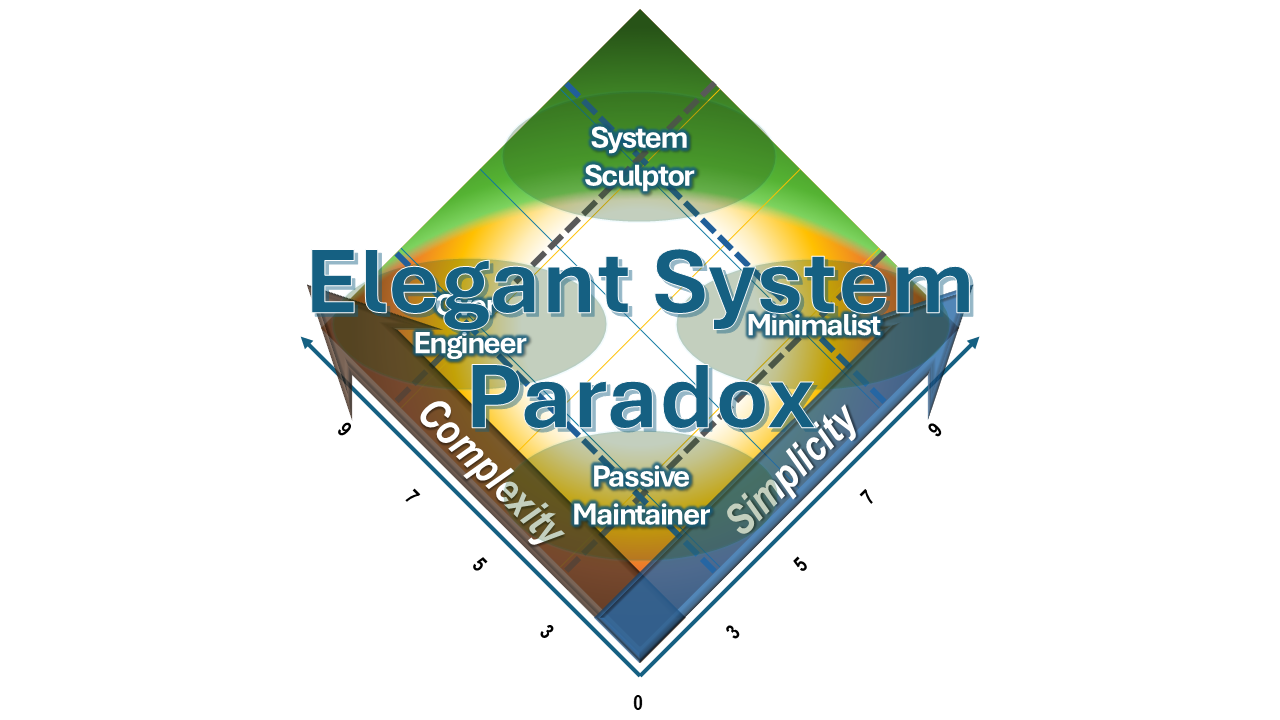
Balancing sophistication with clarity — designing systems rich enough to handle reality, but simple enough for people to actually use. Complexity enables depth and nuance; simplicity enables understanding and execution. When overused, complexity confuses. When oversimplified, meaning gets lost.
DYNAMIC:
The need for straightforward, easy-to-understand people processes and decisions "Complexity seeks depth, detail, and interconnection. It thrives on rich systems that capture reality in full color. Complex thinkers see patterns, relationships, and exceptions others miss. But when overextended, complexity breeds confusion — too many layers, dependencies, or rules. The system becomes brilliant in theory but unusable in practice."
PASSIVE:
The importance of acknowledging the intricacies and nuances of people issues "Simplicity seeks clarity, elegance, and ease. It distills what matters most, translating ideas into something anyone can act on. Simple thinkers cut through noise and keep purpose visible. Yet, when overused, simplicity turns shallow — stripping nuance until decisions feel naive or misleading."
BP:
The System Sculptor | Builds solutions that are both insightful and intuitive. Knows that simplicity is the reward for mastering complexity, not escaping it. Chooses elegance over excess.
Pros:
Balanced design: deep enough for experts, clear enough for everyone.
Systems scale gracefully without overwhelming users.
Encourages understanding and autonomy.
High adoption rates because clarity breeds confidence.
Continuous refinement keeps tools relevant and usable.
Cons:
Time-intensive refinement cycle.
Risk of endless iteration to reach “just right.”
Requires humility to trim one’s own cleverness. | Users can explain processes in plain language.
Documentation is brief yet sufficient.
Teams feel empowered, not dependent. | What adds value, and what just adds weight?
Does this structure serve clarity or complexity itself?
Have we simplified the experience without dumbing it down? | Design systems like sculptures — remove until essence remains. Beauty in work is found not in what’s added, but in what’s unnecessary and left out. |
DI: Oversimplified
The Over-Engineer | Thrives on complexity for its own sake. Plans every contingency, adds every rule, creates systems too intricate for practical life.
Pros:
Impressive technical precision and foresight.
Thorough documentation and strong risk coverage.
High intellectual satisfaction.
Cons:
Users disengage from confusion.
Decision speed plummets.
Maintenance consumes creative bandwidth.
People follow rules instead of reasoning. | “We need another layer” is the default answer.
Systems require translation by experts.
High compliance, low understanding. | Are we solving problems or showcasing design?
What if we removed half this structure — what would break?
Do people feel empowered or dependent on specialists? | Simplify deliberately. Eliminate one rule, one report, one approval loop per quarter. Complexity should serve users, not impress designers. |
GI: Complicated
The Minimalist | Worships simplicity and speed. Cuts corners for convenience, oversimplifies nuanced work. Builds clarity quickly — but at the cost of completeness.
Pros:
Easy onboarding and communication.
Quick implementation and decision flow.
Visually clean, emotionally calming environment.
Cons:
Lacks resilience to handle exceptions.
Hidden dependencies cause surprises later.
Feels “too neat” — problems reappear under stress.
Depth lost, expertise undervalued. | “Keep it simple” used to dismiss hard questions.
Decisions made without full context.
Metrics tell a partial story. | What did we remove that still matters?
Is clarity masking complexity or managing it?
Would this system still work when strained? | Simplicity should emerge from understanding, not avoidance. Keep one extra layer of depth for when life gets messy. Mastery makes complexity invisible — not nonexistent. |
BD: Oversimplified
The Passive Maintainer | Neither questions complexity nor pursues clarity. Accepts systems as they are. Follows routines without curiosity or critique.
Pros:
Stable and predictable rhythm.
Low disruption and consistent habits.
Cons:
Hidden inefficiencies accumulate.
No ownership for improvement.
Innovation and morale fade.
Fragile when external change arrives. | “That’s just how we do it.”
No one knows who designed the current process.
Frequent workarounds that never reach documentation. | What processes do people quietly hate?
Where does confusion happen repeatedly?
What could we remove to make work feel lighter? | Reclaim awareness. Map what you do and why. Invite users to co-design improvements. Simplification starts with curiosity, not expertise. |